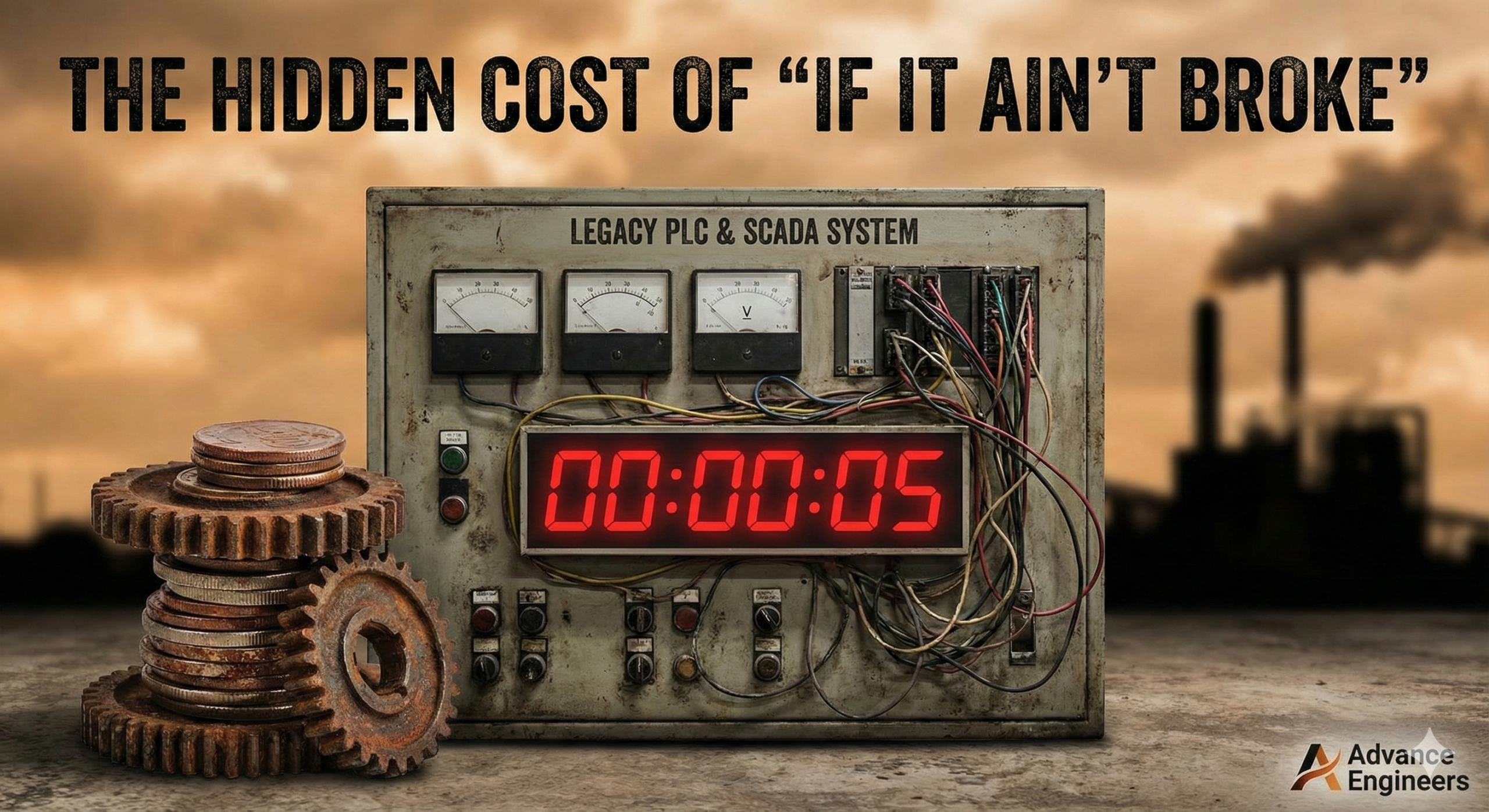
The Hidden Cost of “If It Ain’t Broke”: Why Clinging to Legacy PLC & SCADA Systems is a Ticking Time Bomb for Your Plant
Introduction: The Silent Threat on Your Factory Floor
Walk into many established manufacturing plants across India—from the textile mills of Ludhiana to the pharmaceutical hubs of Baddi and the automotive ancillary units around Chandigarh—and you’ll find a common, silent hero. In a corner of a control room, inside a dusty panel, a Programmable Logic Controller (PLC) has been faithfully executing its logic for 15, 20, perhaps even 25 years. Its corresponding Supervisory Control and Data Acquisition (SCADA) system runs on a PC with an operating system that Microsoft stopped supporting a decade ago.
The prevailing philosophy is simple and, on the surface, prudent: “If it ain’t broke, don’t fix it.”
This mindset views automation upgrades as an unnecessary expense, a disruption to production that offers little tangible return. Why replace a Siemens S7-300 or an Allen-Bradley SLC 500 that’s still blinking its green “RUN” light?
At Advance Engineers, we understand this perspective. We’ve spent over a decade working side-by-side with plant managers and maintenance teams. We know the pressure to keep costs down and production up. But we also know the uncomfortable truth that lies beneath the surface of a legacy system.
The “if it ain’t broke” philosophy is a dangerous illusion. Your legacy system is breaking; it’s just doing so in ways that aren’t immediately obvious—until the day it fails catastrophically. The true cost of keeping a legacy system isn’t zero; it’s a mounting debt of risk that you will eventually have to pay, often at the worst possible moment.
This blog post is a deep dive into the hidden costs of legacy automation. We will move beyond the fear-mongering and provide a clear, technically sound, and business-focused argument for why planning a migration strategy now is the most responsible decision you can make for your plant’s future. We’ll explore the technical pitfalls, build the business case for modernization, and outline a practical, phased approach to upgrading your control systems without bringing your plant to a standstill.
Part 1: The Three Pillars of Legacy Risk
A legacy system is generally defined as one that is no longer available for purchase, is no longer supported by the manufacturer, or cannot run on modern operating systems. The risk it poses can be broken down into three main categories.
1. The Hardware Obsolescence Trap: Searching for Unicorns
The most immediate and tangible threat is hardware failure. Electronic components have a finite lifespan. Capacitors dry out, solder joints degrade, and power supplies fail. When a 20-year-old PLC CPU or a specialized I/O card dies, you cannot simply order a new one from the manufacturer.
You are forced into the grey market. You’re scouring eBay, calling obscure surplus vendors, or hoping a contact in another plant has a spare gathering dust on a shelf. The cost of these “refurbished” parts is often astronomically higher than their original list price—sometimes 500% to 1,000% more.
And what are you buying? A component of unknown history. Was it pulled from a working machine, or was it subjected to voltage spikes? You have no way of knowing. You are paying a premium for an unreliable part to fix a critical failure, all while your production line stands still.
Consider the cost of downtime in your facility. Is it ₹50,000 per hour? ₹2 Lakhs? More? A multi-day outage while you hunt for a rare processor card can easily wipe out an entire year’s maintenance budget.
2. The “Brain Drain” and Support Void
The human element is just as critical as the hardware. The engineers and technicians who originally installed and programmed your legacy systems are retiring. They carry with them decades of tribal knowledge—the intuitive understanding of the system’s quirks, the undocumented workarounds, the “ghosts in the machine.”
The new generation of controls engineers is trained on modern platforms like TIA Portal, Studio 5000, and web-based SCADA systems. Asking a young engineer to troubleshoot a PLC-5 program using DOS-based software is like asking a modern app developer to write code on punch cards. It’s inefficient, frustrating, and prone to error.
Furthermore, vendor support for these systems is non-existent. If you encounter a complex software bug or a communication issue, there is no hotline to call. You are on your own.
3. The Cybersecurity Sieve
In the era of Industry 4.0, connectivity is king. But connecting a Windows XP-based SCADA machine to your plant network is like leaving your front door wide open in a high-crime neighborhood.
Legacy operating systems have countless unpatched security vulnerabilities. They are easy targets for malware, ransomware, and malicious actors. A single infected USB drive plugged into an old HMI can compromise your entire network, leading to data theft, loss of process control, or a complete encryption of your servers with a ransom demand.
Modern systems are built with “security by design,” featuring user authentication, encrypted communications, and role-based access control. Legacy systems were built for a world where “air-gapping” was the only security measure—a measure that is practically impossible to maintain in today’s connected manufacturing environment.
Part 2: The Business Case for Modernization (Beyond Avoiding Disaster)
The argument for upgrading isn’t just about avoiding a negative; it’s about gaining positives. A modern control system is a platform for growth and efficiency.
1. Unlocking Process Visibility with Modern SCADA
Old SCADA systems were essentially digital mimic panels. They showed you if a pump was on or off, a tank level, and maybe a simple trend graph.
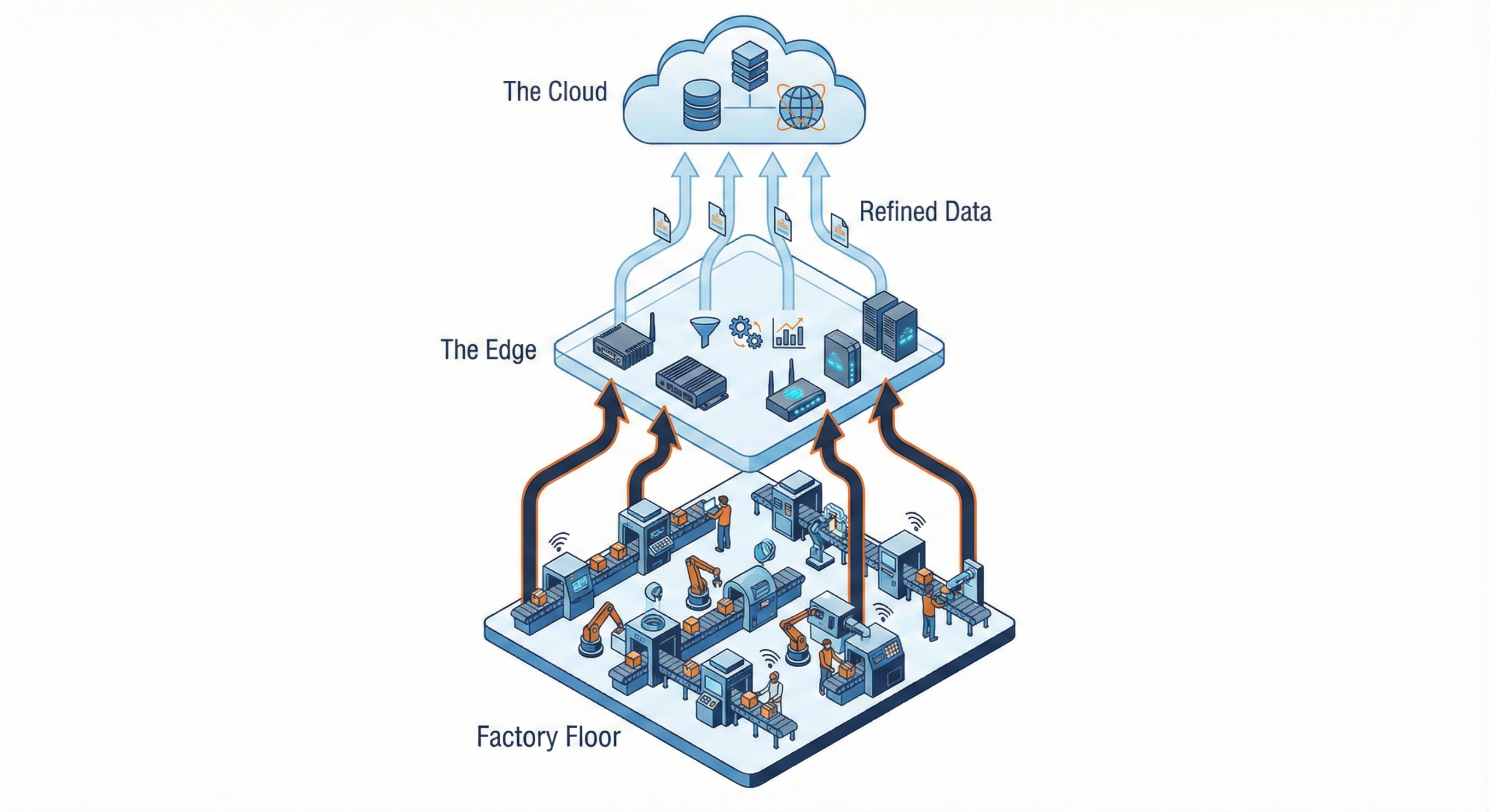
Modern SCADA platforms, like those we deploy at Advance Engineers, are powerful data hubs. They offer:
High-Performance HMI Graphics: Designed for immediate situational awareness, helping operators spot abnormal conditions before they become alarms.
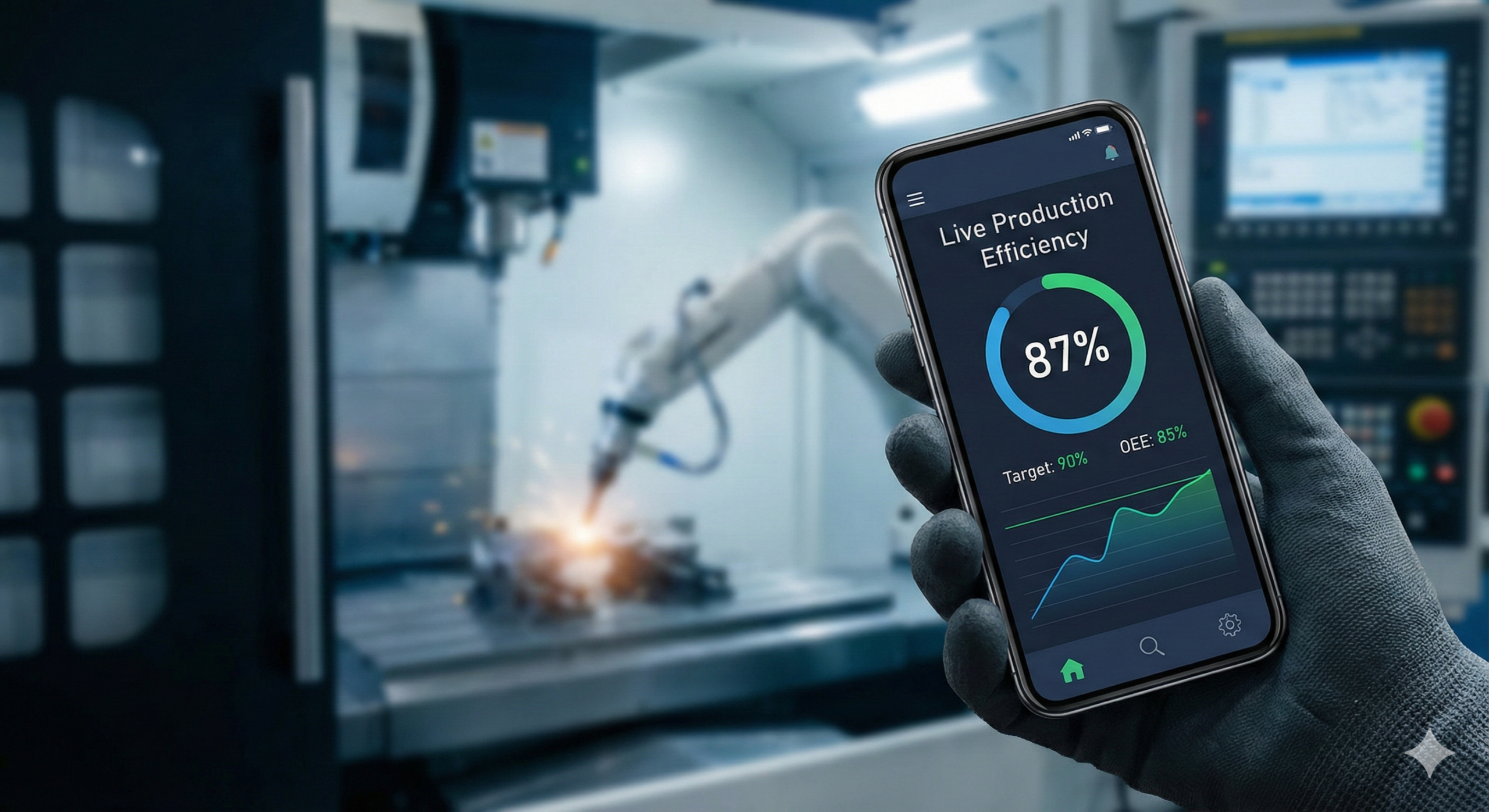
Historian & Analytics: Instead of just logging data, modern systems can analyze it. You can correlate batch quality with process parameters, identify micro-stoppages, and calculate Overall Equipment Effectiveness (OEE) in real-time.
Web & Mobile Access: Plant managers can monitor critical KPIs from their smartphones, tablet, or laptop, anywhere in the world, via secure web clients.
2. Enhanced Diagnostics and Reduced Mean Time To Repair (MTTR)
When a legacy machine stops, the troubleshooting process is often manual and tedious. A technician has to grab a multimeter, open panels, trace wires, and hook up a laptop to look at ladder logic.
Modern PLCs and devices offer rich diagnostic data directly on the HMI. A drive fault isn’t just a generic red light; the HMI tells you exactly what happened: “VFD-101 Overcurrent Fault.” The PLC code can be structured with built-in alarm handling that points the operator directly to the root cause, slashing downtime from hours to minutes.
3. Future-Proofing and Scalability
Your plant is not static. You add new product lines, expand capacity, and integrate new technologies. A legacy control system is a bottleneck to this growth. Adding a new station to an old PLC-5 network or integrating a modern robot with an old S7-300 can be a nightmare of compatibility issues and custom communication drivers.
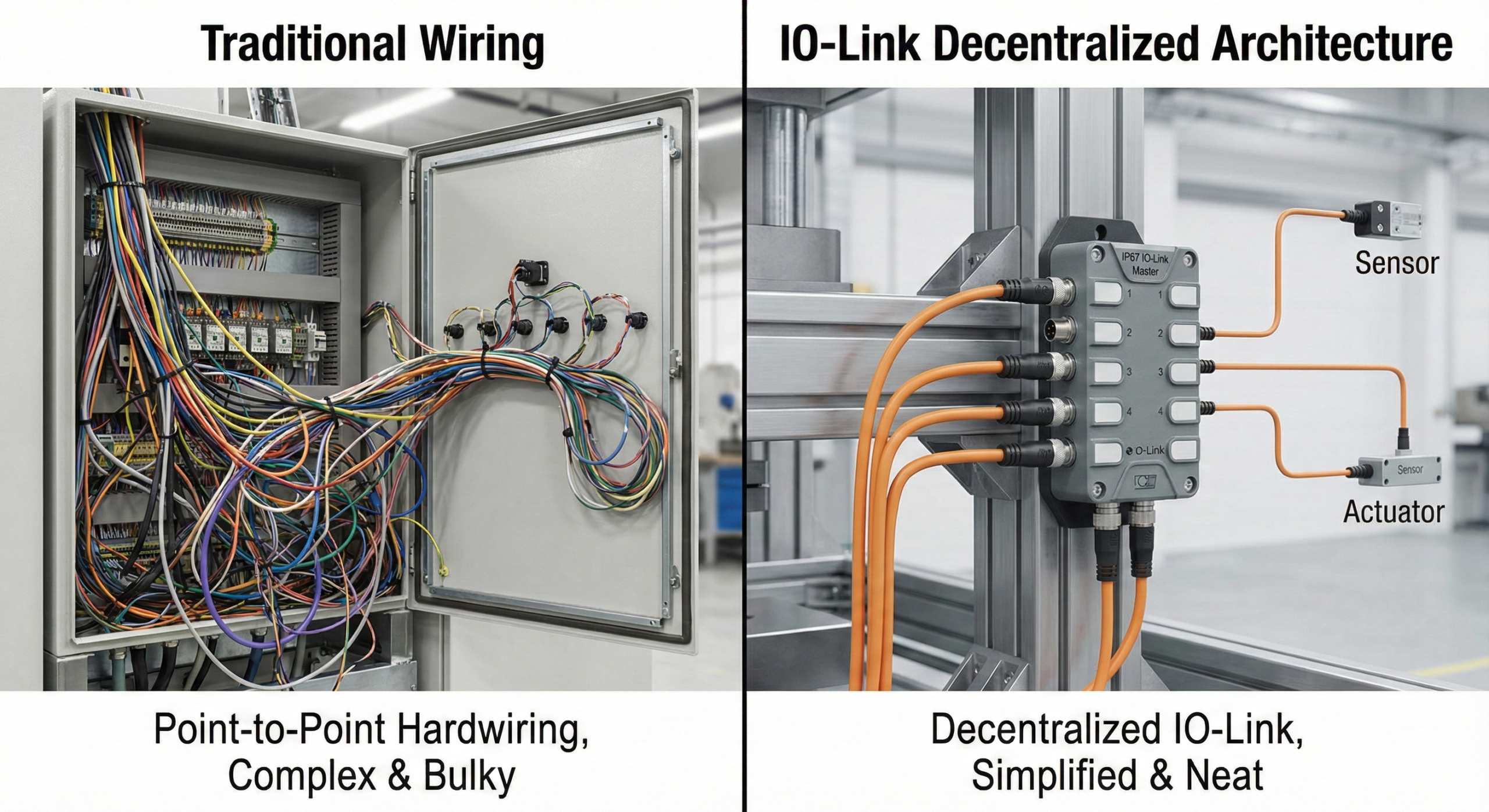
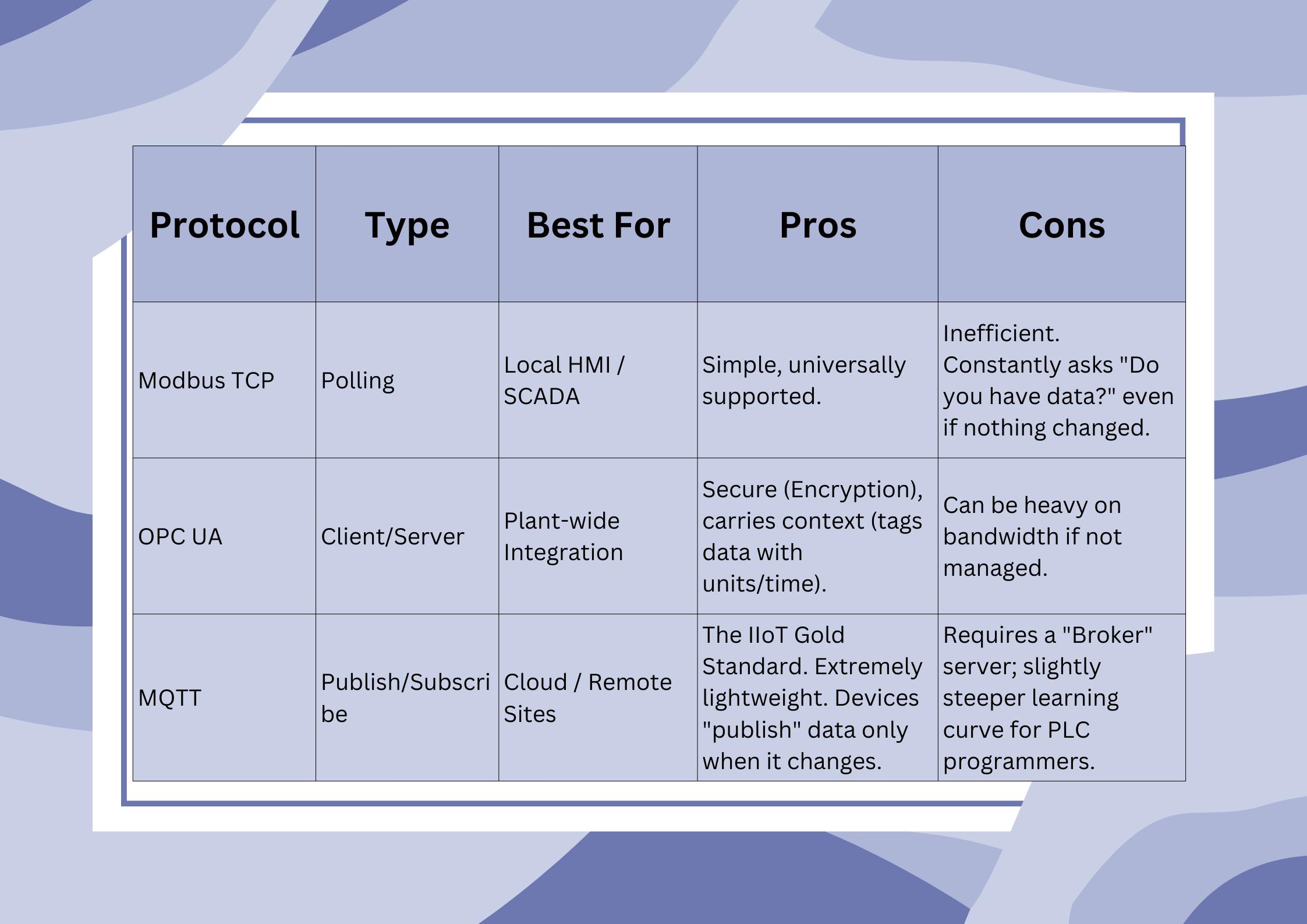
Modern controllers like the Siemens S7-1500 or Allen-Bradley ControlLogix are designed for scalability. They support open standard protocols like OPC UA, Modbus TCP, and EtherNet/IP, making integration with new machinery, MES (Manufacturing Execution Systems), and ERP systems seamless. You are building a foundation that will support your plant for the next 20 years.
Part 3: The Advance Engineers Approach to Low-Risk Migration
The biggest fear holding back migration projects is the risk of the upgrade itself. “What if the new system doesn’t work? What if we’re down for weeks during the changeover?”
At Advance Engineers, we specialize in risk-mitigated migration. We don’t just “rip and replace.” We follow a structured, phased approach designed to ensure zero unplanned downtime.
Phase 1: The Comprehensive Audit and Front-End Engineering Design (FEED)
We start by understanding what you have. This isn’t just a list of part numbers. We perform a deep dive:
Hardware Audit: Documenting every PLC, I/O card, drive, HMI, and communication module. We assess their lifecycle status and availability of spares.
Software Audit: We upload the current running program from the PLC. Crucially, we don’t just rely on the last saved copy on your server, which is often outdated. We analyze the code structure, identify complex algorithms, communication blocks, and undocumented forcing.
Functional Specification: We work with your operators and process engineers to document how the machine actually works, not just how it was designed to work 20 years ago. This is where we capture the tribal knowledge.
Risk Assessment: We identify critical process steps, safety interlocks, and potential failure points during migration.
This phase culminates in a detailed FEED report, outlining the new hardware architecture, the migration strategy, a project timeline, and a fixed cost.
Phase 2: Offline Engineering and Simulation
This is where 80% of the work happens, and it all takes place away from your production line.
Code Conversion & Re-engineering: We use automated tools to convert the base logic (e.g., from S5 to S7), but a human engineer reviews and re-writes critical sections. We don’t just convert “spaghetti code”; we structure it according to modern standards like ISA-88 for batch control, making it readable and maintainable.
SCADA Development: We build the new SCADA screens, incorporating modern high-performance HMI principles while ensuring familiarity for your operators so the learning curve is gentle.
The “Digital Twin” Simulation: Before we touch your live system, we test the new PLC code and SCADA against a simulation of your process. We verify interlocks, alarm handling, sequences, and communication paths in a safe, virtual environment. This step is critical for catching 95% of bugs before commissioning.
Phase 3: Phased Implementation and Commissioning
We rarely recommend a “big bang” cutover over a single weekend. Instead, we prefer a phased approach that minimizes risk.
Parallel Operation Strategy: For critical processes, we can install the new PLC alongside the old one. We use gateway devices to map the old I/O to the new processor. The new PLC runs in “shadow mode,” reading inputs and executing logic, but its outputs are disabled. We compare its behavior to the legacy system in real-time to validate performance.
Station-by-Station Migration: In a multi-station assembly line, we can migrate one station at a time, during scheduled maintenance windows, proving each section before moving to the next.
The Final Cutover: When confidence is high, we perform the final switch. Because of the extensive simulation, this is often as simple as moving I/O connectors to new terminal blocks and enabling the outputs on the new PLC.
Phase 4: Training and Support
A new system is useless if your team can’t use it. We provide:
Operator Training: Hands-on training on the new HMI/SCADA, focusing on how to run the process, handle alarms, and perform basic troubleshooting.
Maintenance Training: Deep-dive training for your controls team on the new PLC hardware, software (e.g., TIA Portal), how to go online, monitor logic, and force I/O safely.
Post-Commissioning Support: We don’t just disappear. We provide on-site support during initial production runs and remote support thereafter to address any teething issues.
Specific Migration Scenarios We Handle
Siemens S5 to S7-1500: A very common and critical upgrade. We handle the complex conversion of S5’s statement list (STL) and absolute addressing to the structured, symbolic tagging of the S7-1500 world, along with replacing PROFIBUS DP with PROFINET.
Allen-Bradley PLC-5/SLC 500 to ControlLogix/CompactLogix: We utilize Rockwell’s migration tools and our own expertise to convert ladder logic and leverage the power of the Logix platform’s tag-based architecture. We can often reuse existing 1771 or 1746 I/O racks in the first phase to reduce initial wiring costs.
Legacy SCADA (e.g., older WinCC, Wonderware, RSView32) to Modern Platforms: We migrate your graphics, alarm databases, and historical data to modern, web-enabled platforms like Ignition, WinCC Unified, or FactoryTalk View SE.
Conclusion: The Choice is Yours—Plan or Panic?
The question is not if you will have to replace your legacy automation systems, but when and how.
You can wait for a catastrophic failure to force your hand. This path guarantees maximum downtime, premium pricing for emergency parts and labor, and immense stress on your entire organization. It’s management by panic.
Or, you can choose the path of planned modernization. This path puts you in control. It allows you to budget for the project, schedule it during planned shutdowns, and execute it with a defined scope and minimized risk. It turns a potential disaster into a strategic initiative that improves your plant’s reliability, efficiency, and competitiveness.
At Advance Engineers, we are more than just system integrators; we are your partners in this critical transition. We have the deep technical expertise in both legacy and modern platforms, combined with a project management methodology designed for the realities of a 24/7 manufacturing environment.
Don’t let an obsolete controller dictate your plant’s future. Take control today.
Are you sitting on a legacy automation time bomb? Let’s defuse it together.
Contact Advance Engineers today for a no-obligation consultation. We can perform an initial audit of your installed base, help you assess your risk, and outline a preliminary roadmap for a phased, low-risk migration.
Schedule a Meeting with Our Automation Migration Experts and secure your plant’s future. https://go.aecl.in/MSBMEETING