The Complete Engineering Guide to Plate Heat Exchanger Descaling
Why Plate Heat Exchangers Lose Efficiency and How Modern Chemical-Free Descaling Can Restore Performance
By Advance Engineers India Pvt. Ltd.
Introduction
Every manufacturing plant depends on one invisible component that silently determines its energy efficiency, production capacity, maintenance costs and equipment reliability—the heat exchanger.
Whether it is a refinery, pharmaceutical plant, dairy, food processing unit, HVAC system, paper mill, textile factory or chemical process industry, heat exchangers are responsible for transferring thermal energy from one process fluid to another with maximum efficiency.
Among all heat exchanger designs, the Plate Heat Exchanger (PHE) has become one of the most preferred choices because of its compact size, excellent thermal efficiency and ease of maintenance.
However, there is one problem that every plant engineer eventually faces.
Scaling.
No matter how sophisticated the plant is, no matter how expensive the heat exchanger is, scale formation gradually reduces performance.
Most industries accept scaling as unavoidable.
At Advance Engineers, we don’t.
Over the last several years, we have worked with industries where scaling has silently increased steam consumption, raised electricity bills, reduced production capacity and forced expensive shutdowns—all without the maintenance team realizing how much money was actually being lost every single day.
This guide explains why that happens.
More importantly, it explains how industries can begin looking beyond traditional chemical cleaning and adopt sustainable methods that reduce maintenance while improving overall plant efficiency.
What is a Plate Heat Exchanger?
A Plate Heat Exchanger is a compact heat transfer device consisting of thin corrugated metal plates clamped together.
The hot fluid flows on one side of each plate.
The cold fluid flows on the opposite side.
Heat passes through the stainless steel plates without the fluids mixing together.
Because of the extremely high turbulence generated by the corrugations, Plate Heat Exchangers provide excellent heat transfer coefficients compared to shell-and-tube exchangers.
Advantages include:
- High thermal efficiency
- Compact footprint
- Low hold-up volume
- Easy expansion
- Easy maintenance
- High heat transfer coefficient
- Lower capital cost
- Faster temperature response
This is why Plate Heat Exchangers are extensively used in:
- Refineries
- Pharmaceutical manufacturing
- Food processing
- Dairy industries
- Breweries
- HVAC systems
- District cooling
- Power plants
- Chemical industries
- Sugar plants
- Textile processing
- Paper manufacturing
Yet every one of these industries faces the same enemy.
Scaling.
Understanding Heat Transfer
To understand why scaling is dangerous, we first need to understand how heat transfer occurs.
Whenever two fluids at different temperatures are separated by a metal plate,
Heat moves naturally from the hotter fluid toward the colder fluid.
The rate of heat transfer depends upon:
• Surface Area
• Temperature Difference
• Plate Material
• Plate Thickness
• Overall Heat Transfer Coefficient (U)
The governing equation is
Q = U × A × ΔT
where
Q = Heat Transfer Rate
U = Overall Heat Transfer Coefficient
A = Surface Area
ΔT = Log Mean Temperature Difference
Notice something important.
Only one parameter continuously changes during plant operation.
U.
Whenever scaling increases,
U decreases.
As U decreases,
Heat transfer decreases.
As heat transfer decreases,
Steam consumption increases.
Production drops.
Pumps consume more power.
Pressure losses increase.
Maintenance costs rise.
The Silent Killer Called Scaling
Scaling is simply the accumulation of unwanted deposits on the heat transfer surface.
These deposits may appear harmless.
Sometimes they are hardly visible.
Yet they behave like thermal insulation.
Imagine trying to cook food using a pan wrapped in a thick blanket.
That is exactly what scaling does.
Instead of allowing heat to pass through stainless steel,
it forces heat to travel through an insulating mineral layer.
Types of Scale Found Inside Plate Heat Exchangers
Industrial water contains dissolved minerals.
Depending upon water chemistry,
temperature,
velocity
and operating conditions,
different types of deposits are formed.
The most common are
Calcium Carbonate
Commonly called lime scale.
Forms when hardness salts precipitate.
Very common in cooling water.
Magnesium Salts
Often found in groundwater applications.
Creates hard deposits.
Silica Deposits
One of the hardest scales to remove.
Common in high temperature applications.
Iron Oxides
Rust generated due to corrosion.
Often mixed with hardness scale.
Biological Fouling
Algae
Bacteria
Biofilm
Organic matter
Extremely common in cooling towers.
Mixed Fouling
Most industrial heat exchangers actually contain multiple deposit types simultaneously.
This makes cleaning much more difficult.
Why Scaling Happens Faster Than Expected
Many engineers assume scaling occurs only because water is hard.
In reality,
scale formation depends upon multiple operating parameters.
These include:
Water hardness
Temperature
Velocity
Pressure
pH
Residence time
Flow imbalance
Dead zones
Heat flux
Surface roughness
Shutdown cycles
Even excellent quality water can eventually produce deposits if operating conditions favour precipitation.
How Just One Millimetre of Scale Can Become Extremely Expensive
One millimetre.
It hardly seems significant.
Yet from a heat transfer perspective,
it changes everything.
The thermal conductivity of stainless steel is roughly
16 W/m·K.
The thermal conductivity of calcium carbonate scale is approximately
2 W/m·K.
That means heat now encounters an insulating layer almost eight times more resistant than stainless steel.
The result is immediate.
Reduced heat transfer.
Higher steam demand.
Longer heating cycles.
Higher fuel consumption.
Lower production.
More maintenance.
This is one reason why many plants unknowingly pay lakhs of rupees every year simply because scaling remains unnoticed.
Hidden Symptoms of Plate Heat Exchanger Scaling
Many maintenance teams don’t realize scaling is occurring because the process continues operating.
However,
certain warning signs begin appearing.
These include
Increasing pressure drop
Higher pump current
Reduced outlet temperature
Longer batch time
Higher steam consumption
Frequent chemical cleaning
Production bottlenecks
Uneven heating
Flow imbalance
Valve opening increasing over time
Increasing utility bills
Whenever several of these symptoms appear together,
the root cause often lies inside the heat exchanger.
The Real Cost of Ignoring Scaling
The direct cleaning cost is only one small part of the total financial loss.
The larger losses include:
Extra electricity
Extra steam
Extra fuel
Production loss
Shutdown cost
Maintenance manpower
Chemical purchase
Waste disposal
Equipment damage
Inventory delay
Product quality variation
Carbon emissions
When all these factors are considered together,
many plants discover that scaling costs several times more than expected.
Why Traditional Chemical Cleaning Is No Longer Enough
For decades,
acid cleaning has been considered the standard solution.
While it certainly removes deposits,
it also introduces new challenges.
Chemical handling risks.
Plant shutdown.
Production interruption.
Spent chemical disposal.
Operator safety.
Repeated gasket replacement.
Potential corrosion.
Environmental compliance.
Most importantly,
chemical cleaning is reactive.
It removes scale only after the problem becomes severe.
Modern industries are increasingly looking towards preventive maintenance strategies that minimize fouling before it affects production.
Sustainability is Driving a New Way of Thinking
Industrial sustainability is no longer limited to reducing electricity consumption.
Today’s manufacturing leaders are expected to improve:
Water efficiency
Energy efficiency
Carbon footprint
Chemical reduction
Waste reduction
Equipment life
Maintenance optimisation
ESG reporting
Environmental compliance
Every avoided chemical cleaning cycle contributes directly towards these objectives.
This is why industries across pharmaceuticals, food processing, oil & gas, chemicals and utilities are evaluating cleaner and more sustainable alternatives for water treatment and scale prevention.
What This Guide Will Cover Next
In the next part of this engineering guide, we will move beyond the problem and focus on practical solutions.
We will discuss:
- How chemical-free descaling technologies work
- The engineering principles behind AE Flux Descaler
- Comparison with conventional acid cleaning
- Detailed Plate Heat Exchanger case study
- Engineering calculations
- Energy savings
- Steam savings
- ROI calculations
- Expected payback period
- Carbon emission reduction
- Frequently asked engineering questions
If your Plate Heat Exchangers require frequent chemical cleaning or your energy consumption has been steadily increasing, the next section will help you evaluate whether a preventive descaling solution can deliver measurable operational and financial benefits.
Ready to Calculate Your Savings?
Every heat exchanger is different.
The amount of savings depends on your operating hours, water quality, energy cost and maintenance practices.
To estimate the expected payback for your application, visit our online AE Flux Payback Calculator and explore how chemical-free descaling can improve your plant efficiency.
👉 https://advance-engineers.com/wateraeflux/
Our engineering team will be happy to review your application and recommend the most suitable AE Flux solution for your plant.
Because every unit of energy saved is energy generated.
SECTION 2 – The Science Behind Chemical-Free Descaling
How AE FLUX Descaler Restores Heat Exchanger Efficiency Without Chemicals
Introduction
In the previous section, we discussed how scale formation gradually reduces the efficiency of Plate Heat Exchangers and why it silently increases operating costs.
The next logical question every engineer asks is:
Can scaling be prevented without shutting down the plant and without using chemicals?
For decades, industries have believed that acid cleaning is the only practical solution.
However, with increasing focus on sustainability, ESG compliance, reduced maintenance costs and improved equipment life, industries across the world are actively looking for technologies that prevent scaling instead of periodically removing it.
AE FLUX Descaler has been developed keeping exactly this philosophy in mind.
Instead of waiting for the heat exchanger to become heavily fouled, AE FLUX continuously conditions the circulating water so that scale formation is minimized while existing deposits gradually become less adherent and easier to remove through normal flow conditions.
It is a preventive engineering solution rather than a corrective maintenance activity.
Why Prevention is Better than Cure
Consider two plants operating identical Plate Heat Exchangers.
Plant A
Operates normally.
Every 6 months:
Production stops.
Acid cleaning is carried out.
Gaskets are inspected.
Chemicals are purchased.
Waste chemicals are disposed.
Production resumes.
The cycle repeats every year.
Plant B
Uses a preventive descaling technology.
The heat exchanger continues operating.
Scale deposition is minimized.
Heat transfer remains consistent.
Shutdown intervals become longer.
Maintenance reduces.
Utility costs remain under control.
Which plant has the lower life-cycle cost?
The answer is obvious.
Modern industries are gradually shifting from reactive maintenance to predictive and preventive maintenance.
AE FLUX fits perfectly into this philosophy.
Understanding Scale Formation at the Molecular Level
To understand how preventive descaling works, it is important to understand how scale is formed.
Industrial water always contains dissolved minerals.
These minerals remain dissolved because of temperature, pressure and water chemistry.
As the water passes through a heat exchanger:
Temperature increases.
Pressure changes.
Velocity changes.
Carbon dioxide escapes.
Minerals begin losing their solubility.
Tiny microscopic crystals start forming.
Initially these crystals remain suspended.
As time passes,
they attach themselves to metallic surfaces.
Layer after layer,
the deposit becomes thicker.
This is the beginning of scale formation.
Once the first layer develops,
future deposits attach much more rapidly.
This explains why scaling accelerates with time.
Why Plate Heat Exchangers are More Susceptible to Scaling
Plate Heat Exchangers provide extremely high heat transfer.
That is their biggest advantage.
Ironically,
that is also one reason scaling develops relatively quickly.
Reasons include:
• Very high surface temperature
• Narrow flow passages
• High turbulence
• Continuous temperature gradients
• High heat transfer rates
Although turbulence helps delay fouling,
once deposits begin forming,
the narrow channels experience increasing pressure drop.
The result is:
Reduced flow.
Lower Reynolds Number.
Reduced turbulence.
More deposition.
Eventually,
the heat exchanger enters a vicious cycle where fouling continuously accelerates.
The Engineering Impact of Fouling
Heat exchanger performance is measured using the Overall Heat Transfer Coefficient (U).
For a clean Plate Heat Exchanger,
the U-value remains close to the design specification.
As scale develops,
an additional thermal resistance appears.
This is called Fouling Resistance (Rf).
The equation becomes:
1/U = 1/h₁ + Rplate + Rf + 1/h₂
Where:
h₁ = Heat transfer coefficient on hot side
h₂ = Heat transfer coefficient on cold side
Rplate = Plate resistance
Rf = Fouling resistance
Notice something important.
Every additional layer of scale increases Rf.
As Rf increases,
overall U decreases.
Therefore,
heat transfer falls.
No operator notices this immediately because production usually continues.
Instead,
steam valves open further.
Boilers consume more fuel.
Pumps work harder.
Electricity consumption rises.
All this happens silently.
The Hidden Energy Loss
Consider a Plate Heat Exchanger transferring process water.
Clean condition:
Overall Heat Transfer Coefficient = 4200 W/m²K
After fouling:
Overall Heat Transfer Coefficient = 3200 W/m²K
Efficiency reduction:
Nearly 24%
Now imagine this exchanger operating:
24 hours/day
330 days/year
The utility losses become enormous.
In many industries,
the energy loss over one year exceeds the purchase price of the heat exchanger itself.
Why Chemical Cleaning Has Limitations
Chemical cleaning certainly removes deposits.
However,
it introduces another set of engineering challenges.
Production Shutdown
Cleaning cannot usually be performed while production continues.
Downtime becomes unavoidable.
Chemical Handling
Acids require proper handling,
storage,
PPE,
neutralisation
and disposal.
Environmental Compliance
Spent chemicals cannot simply be discharged.
They require controlled disposal.
This increases operating costs.
Gasket Life
Repeated dismantling increases gasket wear.
Replacement costs rise over time.
Metal Loss
Aggressive chemicals,
particularly if improperly controlled,
may gradually attack metallic surfaces.
Repeated cleaning reduces equipment life.
Labour Intensive
Cleaning requires:
Isolation
Drainage
Disassembly
Inspection
Chemical circulation
Neutralisation
Flushing
Reassembly
Hydrotesting
Restart
This process consumes both manpower and valuable production hours.
Preventive Descaling Changes the Maintenance Philosophy
Instead of asking:
“How do we remove scale?”
Modern engineers ask:
“How do we reduce scale formation in the first place?”
This shift in thinking has transformed industrial maintenance across the world.
Today,
plants increasingly invest in technologies that
Reduce maintenance
Reduce downtime
Reduce chemicals
Improve sustainability
Increase equipment life
Improve plant availability
This is exactly where AE FLUX creates value.
Introducing AE FLUX Descaler
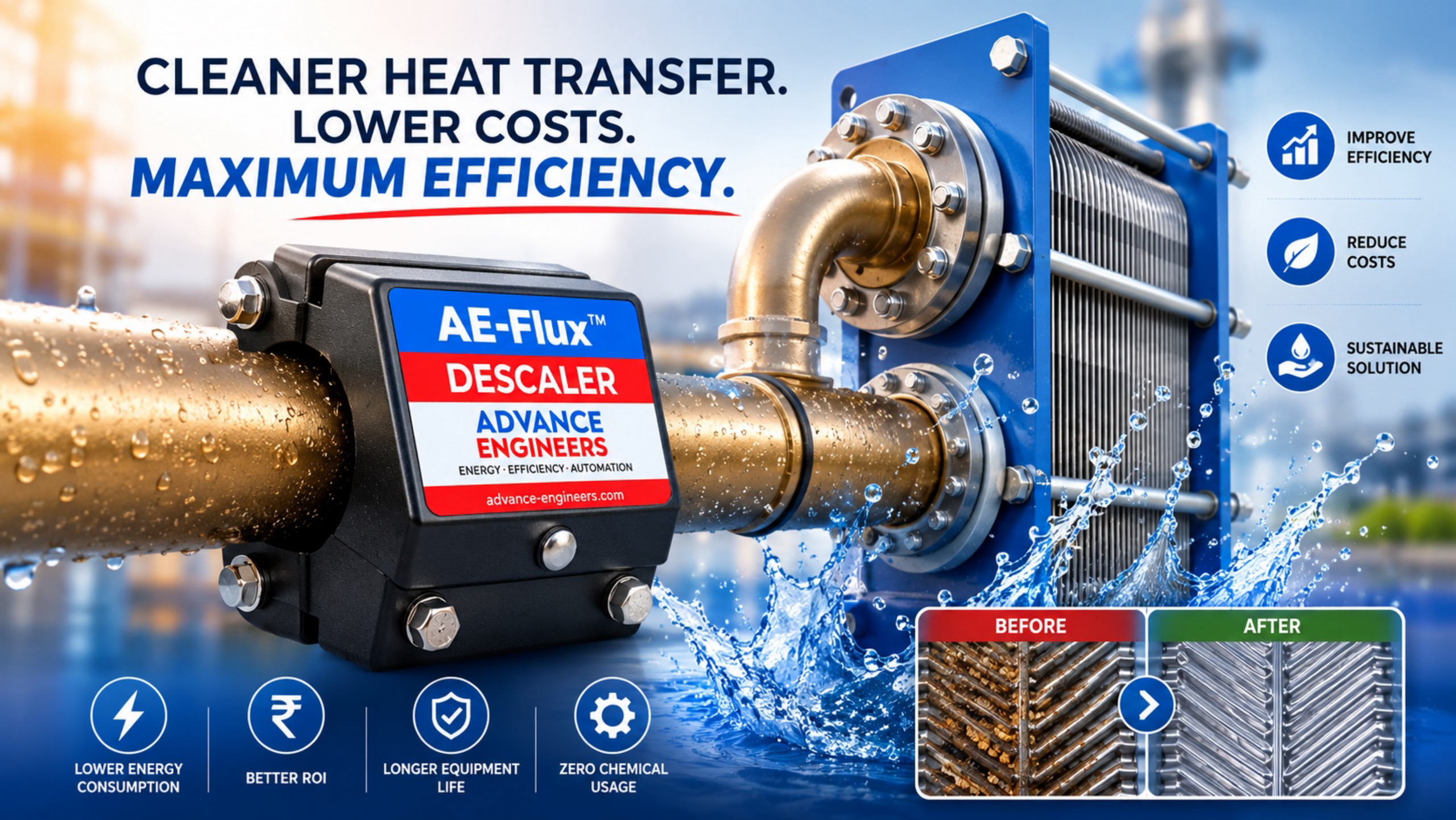
AE FLUX Descaler is a non-invasive inline conditioning device designed to support scale management in industrial water systems.
It is installed externally on the pipeline.
There are:
No moving parts.
No chemicals.
No electricity.
No consumables.
No pressure drop.
No interruption to process flow.
Once installed,
it operates continuously with minimal attention.
Its purpose is to condition flowing water in a manner that helps reduce the tendency of mineral deposits to adhere strongly to heat transfer surfaces, thereby supporting cleaner systems over time.
Typical Applications
AE FLUX Descaler can be considered for:
Plate Heat Exchangers
Shell & Tube Heat Exchangers
Cooling Towers
Chillers
Boilers
Condensers
Cooling Water Lines
Hot Water Circuits
HVAC Systems
Diesel Generator Jacket Cooling
Plastic Injection Moulding
Food Processing
Dairy Plants
Power Plants
Pharmaceutical Utilities
Sugar Mills
Chemical Plants
Oil Refineries
Commercial Buildings
Hotels
Hospitals
Anywhere scaling affects performance,
AE FLUX deserves evaluation.
Expected Operational Benefits
Every application is different.
Performance depends upon:
Water chemistry
Operating temperature
Flow velocity
Existing scale thickness
Operating hours
Maintenance practices
When properly applied,
users typically look for improvements in areas such as:
• More stable heat transfer
• Reduced fouling tendency
• Longer intervals between cleaning
• Lower pressure drop growth
• Reduced maintenance frequency
• Better energy efficiency
• Improved equipment availability
Actual results should always be evaluated based on site operating conditions and performance monitoring.
Engineering Comparison
| Parameter | Conventional Chemical Cleaning | AE FLUX Preventive Descaling |
|---|---|---|
| Plant Shutdown | Required | Normally Not Required |
| Chemicals | Required | Not Required |
| Operator Exposure | High | Negligible |
| Waste Disposal | Required | None |
| Environmental Impact | Higher | Lower |
| Continuous Operation | No | Yes |
| Preventive Action | No | Designed for Continuous Conditioning |
| Maintenance Frequency | Periodic | Reduced Intervention Objective |
| Equipment Opening | Frequent | Less Frequent |
| ESG Friendly | Moderate | Strongly Aligned |
Case Study (Illustrative Example)
Industry: Dairy Processing
Heat Exchanger Duty:
Milk Pasteurization
Problem:
Chemical cleaning every four months.
Steam consumption increasing.
Pressure drop rising.
Frequent maintenance.
Production interruption.
Solution:
AE FLUX installed on the recirculating water line.
Performance Review after several months of operation showed:
• Longer intervals between maintenance
• More consistent outlet temperatures
• Reduced tendency for scaling
• Lower cleaning frequency
• Improved production availability
This illustrative example highlights the type of operational improvements industries seek when implementing preventive descaling solutions. Actual results vary depending on water quality, operating conditions, and maintenance practices.
Sustainability Benefits
Every chemical cleaning cycle avoided contributes to:
Reduced chemical consumption
Reduced transportation
Reduced waste generation
Reduced carbon emissions
Lower water usage
Lower maintenance waste
Longer equipment life
Improved ESG performance
For organizations pursuing sustainability targets,
these operational improvements become strategically important.
The Economics of Preventive Maintenance
Many companies evaluate maintenance only by comparing:
Cost of Chemicals
versus
Cost of AE FLUX.
This is incomplete.
A proper engineering evaluation should include:
Steam Savings
Electricity Savings
Reduced Pumping Energy
Lower Maintenance Labour
Reduced Shutdown Cost
Lower Spare Consumption
Reduced Gasket Replacement
Higher Production Availability
Reduced Water Consumption
Reduced Carbon Cost
When these are considered together,
the economics become far more meaningful.
What’s Coming Next
In the next section of this engineering guide, we will move from concepts to numbers.
We will develop a complete engineering case study for a Plate Heat Exchanger, including:
Actual heat transfer calculations
Steam savings estimation
Fouling factor analysis
Pressure drop comparison
Energy cost calculations
Carbon emission reduction
12-month payback model
5-year Return on Investment (ROI)
Industry-specific applications for pharmaceuticals, refineries, HVAC systems, dairies, food processing, and power plants
The objective is simple: to help plant engineers evaluate preventive descaling using engineering principles and economic analysis rather than assumptions.
Continue Exploring
Want to estimate the potential savings for your own plant?
Visit the AE FLUX page and use the Online Payback Calculator to evaluate your application.
https://advance-engineers.com/wateraeflux/
Our engineering team will be happy to discuss your operating conditions and help determine whether AE FLUX is suitable for your system.
SECTION 3A
Engineering Case Study: Plate Heat Exchanger Descaling Using AE FLUX Technology
Quantifying Energy Savings, ROI and Operational Benefits
The Question Every Plant Head Asks
Whenever a new technology is introduced into a plant, the first question is not:
“How does it work?”
The first question is:
“How much money will it save?”
Plant managers are judged on production.
Utility managers are judged on energy consumption.
Maintenance managers are judged on uptime.
Corporate management is judged on profitability.
Therefore, any technology that claims to improve efficiency must ultimately demonstrate measurable economic value.
This section develops a practical engineering case study showing how scaling impacts heat exchanger performance and how preventive descaling can create significant financial benefits.
Plant Background
Industry: Pharmaceutical Manufacturing
Application: Purified Water Heating System
Heat Exchanger Type: Plate Heat Exchanger
Operating Hours:
24 Hours per Day
330 Days per Year
Operating Hours per Year:
24 × 330
= 7,920 Hours
Design Conditions
Heat Exchanger Duty:
2,500 kW
Heat Transfer Area:
120 m²
Design U Value:
4,500 W/m²K
Heating Medium:
Steam
Process Fluid:
Water
Water Hardness:
350 ppm
Observed Cleaning Frequency:
Every 4 Months
Initial Problem
The maintenance team observed:
Increasing steam consumption
Reduced outlet temperature
Longer heating cycles
Increasing pressure drop
Frequent cleaning requirement
Production interruptions
Escalating maintenance cost
No major mechanical issues were identified.
Investigation revealed progressive scale accumulation inside the Plate Heat Exchanger.
Understanding the Loss Mechanism
The exchanger was originally operating at:
U = 4500 W/m²K
After scaling:
U = 3400 W/m²K
Reduction:
1100 W/m²K
Percentage Reduction:
24.4%
This reduction forced the steam control valve to open further to achieve the required process temperature.
Result:
Higher steam consumption.
Steam Consumption Analysis
Design Steam Consumption:
1,850 kg/hr
Observed Steam Consumption:
2,220 kg/hr
Additional Steam Required:
370 kg/hr
Annual Steam Loss:
370 × 7,920
= 2,930,400 kg/year
= 2,930 Tons per Year
Steam Cost Analysis
Assume Steam Generation Cost:
₹2.80/kg
Annual Steam Loss:
2,930,400 × ₹2.80
= ₹82,05,120
Approximate Annual Loss:
₹82 Lakhs
This loss occurs without any equipment failure.
Simply because of scale.
Electricity Consumption Impact
Scale does not only affect heat transfer.
It also increases pressure drop.
Pressure Drop Clean:
0.75 Bar
Pressure Drop Fouled:
1.25 Bar
Increase:
0.50 Bar
The circulation pump compensates for this resistance.
Pump Motor:
22 kW
Additional Loading:
Approximately 10%
Extra Consumption:
2.2 kW
Annual Consumption:
2.2 × 7,920
= 17,424 kWh
Electricity Cost:
₹8/kWh
Annual Cost:
₹1,39,392
Additional Electricity Cost:
₹1.4 Lakhs per Year
Production Loss Impact
A hidden loss often ignored by industries is reduced throughput.
When heat transfer reduces:
Batch cycles become longer.
Production schedules get delayed.
Utilities remain occupied longer.
Let’s assume:
Production Loss:
1%
Annual Production Value:
₹100 Crores
Potential Impact:
₹1 Crore
Not all of this may be directly recoverable.
However even a fraction becomes significant.
Chemical Cleaning Cost
Each Cleaning Cycle:
Chemicals: ₹40,000
Labour: ₹15,000
Downtime: ₹60,000
Inspection: ₹10,000
Total:
₹1,25,000
Cleaning Frequency:
3 Times per Year
Annual Cost:
₹3,75,000
Total Annual Cost of Scaling
Steam Loss:
₹82.0 Lakhs
Electricity Loss:
₹1.4 Lakhs
Cleaning Cost:
₹3.75 Lakhs
Total Direct Cost:
₹87.15 Lakhs
This excludes:
Production delays
Inventory impact
Carbon cost
Management overhead
Equipment degradation
Introducing AE FLUX Descaler
The plant decided to install an AE FLUX Descaler on the recirculating water system.
Objective:
Reduce scale formation.
Maintain cleaner heat transfer surfaces.
Increase interval between cleaning cycles.
Improve thermal efficiency.
Reduce steam consumption.
Observation Period
Performance was monitored over:
12 Months
Parameters Recorded:
Steam Consumption
Pressure Drop
Outlet Temperature
Maintenance Frequency
Cleaning Requirement
Energy Consumption
Results After Implementation
Observed U Value:
4,150 W/m²K
Original Design:
4,500 W/m²K
Recovery:
750 W/m²K
Efficiency Restoration:
68% of Lost Performance Recovered
Steam Consumption After Installation
Before:
2,220 kg/hr
After:
1,970 kg/hr
Reduction:
250 kg/hr
Annual Saving:
250 × 7,920
= 1,980,000 kg
Annual Cost Saving:
1,980,000 × ₹2.80
= ₹55,44,000
Steam Saving:
₹55.4 Lakhs Per Year
Electricity Savings
Pressure Drop Reduced.
Pump Loading Reduced.
Estimated Annual Saving:
12,000 kWh
Annual Benefit:
₹96,000
Maintenance Savings
Cleaning Frequency Reduced:
From 3 Times
To 1 Time
Annual Saving:
2 × ₹1,25,000
= ₹2,50,000
Total Annual Savings
Steam:
₹55.4 Lakhs
Electricity:
₹0.96 Lakhs
Maintenance:
₹2.5 Lakhs
Total:
₹58.86 Lakhs
Annual Saving:
≈ ₹59 Lakhs
Payback Calculation
Assume Installed AE FLUX Cost:
₹3,50,000
Annual Savings:
₹58,86,000
Payback:
₹3,50,000 ÷ ₹58,86,000
= 0.059 Years
Payback:
Approximately 22 Days
Even if actual savings are only 20% of the calculated value,
the payback remains extremely attractive.
Five-Year ROI
Annual Savings:
₹58.86 Lakhs
Five-Year Savings:
₹2.94 Crores
Investment:
₹3.5 Lakhs
Return Multiple:
84 Times Investment
ROI:
8,400%
Carbon Emission Reduction
Steam generation consumes fuel.
Fuel generates CO₂.
Assume:
1 Ton Steam
≈ 0.20 Ton CO₂
Steam Saved:
1,980 Tons
Carbon Reduction:
396 Tons CO₂
Per Year
Equivalent To:
More than 17,000 mature trees.
This directly contributes to ESG targets.
ESG and Sustainability Benefits
AE FLUX aligns with:
Reduced Energy Consumption
Reduced Fuel Consumption
Reduced Chemical Usage
Reduced Waste Disposal
Reduced Water Consumption
Reduced Carbon Footprint
Reduced Maintenance Waste
Improved Sustainability Metrics
Lessons Learned
The project demonstrated a critical reality.
Most industries underestimate the cost of scaling.
They focus only on cleaning costs.
The real loss lies in:
Energy
Utilities
Production
Downtime
Maintenance
Carbon emissions
Once these factors are quantified,
the economics become compelling.
Key Takeaways
✔ Scale is an energy problem.
✔ Scale is a maintenance problem.
✔ Scale is a sustainability problem.
✔ Preventive descaling often provides better economics than periodic cleaning.
✔ Small improvements in heat transfer can generate disproportionately large financial benefits.
✔ The highest savings usually come from steam-intensive applications.
✔ Plate Heat Exchangers offer one of the fastest payback opportunities for descaling technologies.
Next Chapter
In Section 3B, we will explore industry-specific applications of AE FLUX technology across:
Refineries
Pharmaceutical Plants
Dairy Industries
Food Processing
HVAC Systems
Power Plants
Commercial Buildings
Hotels
Sugar Mills
Chemical Industries
and identify where the largest opportunities for energy savings exist.
Calculate Your Own Savings
Every application is unique.
Calculate the potential savings for your plant using the AE FLUX Online Payback Calculator:
https://advance-engineers.com/wateraeflux/
Or connect with the Advance Engineers team for a detailed application review and ROI assessment.
SECTION 3B
Industry Applications of AE FLUX Descaler
Where Chemical-Free Descaling Delivers the Greatest Value Across Industrial Sectors
Introduction
Every industry uses heat.
Whether it is generating steam, cooling process water, condensing vapours, recovering waste heat or maintaining product temperatures, efficient heat transfer is fundamental to production.
While the equipment may differ from one industry to another, the underlying problem remains remarkably similar.
Scaling.
The consequences are also similar:
Higher energy consumption
Reduced heat transfer
Increased maintenance
Frequent shutdowns
Lower production efficiency
Higher operating costs
The difference lies only in how each industry experiences these losses.
This chapter explores how AE FLUX Descaler can support industries in improving operational efficiency, reducing maintenance interventions and extending equipment life.
1. Oil & Gas Refineries
Typical Applications
Refineries operate thousands of heat transfer points.
Some of the most common applications include:
Plate Heat Exchangers
Shell & Tube Heat Exchangers
Crude Pre-heaters
Condensers
Utility Water Systems
Cooling Water Networks
Boiler Feed Systems
Heat Recovery Systems
Scaling in these systems can have a cascading effect across the plant.
Even a small reduction in heat transfer efficiency can increase fuel consumption significantly because refinery operations are continuous.
Common Challenges
High cooling water hardness
Heat exchanger fouling
Condenser scaling
Increased cooling water demand
Steam losses
Pump overload
Frequent shutdowns
Potential Benefits
Improved heat transfer consistency
Longer intervals between maintenance
Reduced cooling water scaling
Improved energy efficiency
Better equipment availability
Lower maintenance costs
For refineries pursuing ESG initiatives, reducing chemical consumption in utility systems can also contribute to sustainability objectives.
2. Pharmaceutical Industry
The pharmaceutical industry demands consistent temperatures.
Even slight process deviations may affect product quality.
Plate Heat Exchangers are extensively used for:
Purified Water Heating
WFI Systems
Process Cooling
HVAC
Clean Utilities
CIP Systems
Chilled Water Systems
Operational Challenges
Scaling often causes:
Reduced outlet temperature
Longer batch time
Increased steam consumption
Increased cleaning frequency
Higher maintenance effort
Production schedules become increasingly difficult to maintain.
How AE FLUX Can Help
Chemical-free descaling aligns well with pharmaceutical facilities because it supports:
Reduced maintenance interventions
Better utility efficiency
Lower chemical usage in supporting water circuits
Longer equipment life
For GMP environments, minimizing unnecessary maintenance activities is always desirable.
3. Dairy Industry
Milk processing relies heavily on efficient heat transfer.
Applications include:
Pasteurizers
Regenerators
Plate Heat Exchangers
Hot Water Systems
Chillers
CIP Systems
Milk processing often runs continuously during production shifts.
Any loss of heat transfer affects productivity.
Common Problems
Hard water scaling
Steam consumption increase
Longer pasteurization cycles
Production interruptions
Business Impact
Small reductions in thermal efficiency can increase operating costs every hour.
Improving heat transfer stability directly improves profitability.
4. Food Processing Industry
Food manufacturers use Plate Heat Exchangers for:
Sauce production
Beverage heating
Juice processing
Cooking systems
Process water
Utility heating
Because food plants frequently perform cleaning operations,
maintenance downtime directly affects production schedules.
Typical Challenges
Scale formation
Heat transfer reduction
Product inconsistency
Steam losses
Maintaining cleaner heat transfer surfaces supports more stable processing conditions.
5. Beverage Industry
Breweries
Soft Drink Plants
Juice Plants
Distilleries
all depend on accurate temperature control.
Scaling may result in:
Slower cooling
Reduced production
Increased utility bills
Reducing fouling contributes towards better thermal performance throughout the production cycle.
6. HVAC Industry
Commercial HVAC systems represent one of the largest opportunities for energy savings.
Applications include:
Chillers
Condensers
Cooling Towers
Plate Heat Exchangers
District Cooling
Scaling increases:
Chiller compressor load
Pumping energy
Cooling tower demand
Even a small improvement in heat transfer may reduce electricity consumption over thousands of operating hours annually.
7. Hotels and Hospitality
Hotels consume large quantities of hot water every day.
Applications include:
Boiler Systems
Hot Water Generators
Laundry
Swimming Pools
HVAC Systems
Hotels rarely shut down for maintenance.
Therefore,
technologies that reduce maintenance frequency become attractive.
Potential advantages include:
Improved hot water availability
Reduced maintenance
Lower utility bills
Improved guest comfort
8. Hospitals
Hospitals operate continuously.
Reliable utilities are critical.
Applications include:
Hot Water Systems
HVAC
Sterilization Systems
Boiler Systems
Cooling Systems
Maintenance shutdowns must be carefully planned.
Reducing scale formation contributes towards more reliable operation.
9. Chemical Industry
Chemical plants often operate under severe thermal conditions.
Applications include:
Reactors
Condensers
Utility Water
Cooling Water
Heat Recovery
Scaling may reduce:
Product quality
Reactor efficiency
Production capacity
Maintaining heat transfer performance improves process stability.
10. Power Plants
Power stations depend on efficient heat transfer.
Applications include:
Condensers
Sample Coolers
Heat Exchangers
Cooling Water Systems
Auxiliary Cooling
One particularly interesting application discussed with several utilities is the SWAS Sample Cooler.
Scaling inside these coolers affects temperature control and sampling reliability.
Chemical-free descaling may offer an attractive preventive approach for such applications.
11. Sugar Industry
Sugar mills face severe scaling because of:
High temperatures
Mineral-rich water
Continuous operation
Applications include:
Juice Heaters
Evaporators
Condensers
Utility Water
Reducing fouling improves steam economy throughout the season.
12. Textile Industry
Textile plants use hot water extensively.
Applications include:
Dyeing
Washing
Process Heating
Utility Systems
Scaling increases steam demand,
reduces temperature consistency
and increases maintenance.
13. Paper Industry
Paper manufacturing depends heavily on:
Steam
Hot Water
Heat Recovery
Condensers
Paper mills operate continuously.
Utility efficiency directly impacts production cost.
14. Automobile Manufacturing
Automotive plants operate:
Cooling Systems
Paint Shops
HVAC
Utility Water
Reliable cooling improves manufacturing consistency.
15. Plastic Injection Moulding
Cooling determines production speed.
Scaling inside mould cooling circuits increases:
Cycle Time
Cooling Time
Power Consumption
Rejects
Maintaining cleaner cooling systems can improve productivity.
Applications Beyond Plate Heat Exchangers
Although Plate Heat Exchangers are among the most common applications,
AE FLUX can also be evaluated for:
Cooling Towers
Boilers
Condensers
Chillers
Diesel Generator Cooling
Process Water Systems
Heat Recovery Units
HVAC Plants
Industrial Utility Water
Hot Water Loops
Closed Cooling Circuits
Essentially,
wherever mineral deposition affects thermal performance,
preventive descaling deserves consideration.
Industry Selection Matrix
| Industry | Heat Exchangers | Cooling Water | Boilers | Chillers | Typical Benefit |
|---|---|---|---|---|---|
| Refinery | ✓ | ✓ | ✓ | ✓ | Energy & Maintenance |
| Pharma | ✓ | ✓ | ✓ | ✓ | Utility Reliability |
| Dairy | ✓ | ✓ | ✓ | ✓ | Production Efficiency |
| Food | ✓ | ✓ | ✓ | ✓ | Heat Transfer Stability |
| Beverage | ✓ | ✓ | ✓ | ✓ | Energy Savings |
| Chemical | ✓ | ✓ | ✓ | ✓ | Process Reliability |
| HVAC | ✓ | ✓ | — | ✓ | Lower Electricity |
| Hotels | — | ✓ | ✓ | ✓ | Reduced Utility Cost |
| Hospitals | — | ✓ | ✓ | ✓ | Reliability |
| Power Plants | ✓ | ✓ | ✓ | ✓ | Heat Transfer Efficiency |
| Sugar | ✓ | ✓ | ✓ | — | Steam Economy |
| Textile | ✓ | ✓ | ✓ | — | Lower Energy |
| Paper | ✓ | ✓ | ✓ | — | Continuous Production |
How to Identify a Good Candidate for AE FLUX
A system may be a suitable candidate for evaluation if it experiences one or more of the following:
Frequent descaling
Acid cleaning every few months
Increasing steam consumption
Rising electricity bills
Reduced heat exchanger performance
High pressure drop
Repeated maintenance shutdowns
Hard water conditions
Frequent gasket replacement
Persistent scaling despite water treatment
If multiple symptoms are present, it is worthwhile conducting a technical assessment.
A Word from Advance Engineers
At Advance Engineers, we believe that every application deserves an engineering study before recommending any solution.
No two plants are identical.
Water chemistry differs.
Operating conditions differ.
Production priorities differ.
Instead of offering a standard product recommendation, our engineering team works with customers to understand:
Process requirements
Water quality
Operating temperatures
Maintenance history
Utility costs
Existing challenges
This enables us to recommend the most appropriate solution for each application.
Coming Up Next
In the final chapter of this Engineering Guide, we will cover:
The Complete Buyer’s Guide for Industrial Descalers
50 Frequently Asked Questions
Installation Best Practices
Maintenance Guidelines
Equipment Selection Criteria
Common Myths About Descaling
ESG and Sustainability Benefits
Why More Industries Are Moving Towards Chemical-Free Water Conditioning
Final Recommendations from Advance Engineers
By the end of this guide, readers will have a practical framework for evaluating descaling solutions based on engineering principles, operational needs and long-term economics rather than assumptions alone.
SECTION 3C
The Complete Buyer’s Guide to Industrial Descaling
How to Select the Right Chemical-Free Descaling Solution for Plate Heat Exchangers, Cooling Water Systems, Chillers and Industrial Utilities
Introduction
Buying a descaling solution should never be an emotional decision.
Neither should it be based solely on the lowest price.
As engineers, we are trained to evaluate systems based on measurable performance, reliability, lifecycle costs and return on investment.
Unfortunately, many industries still purchase descaling products after experiencing repeated failures, increasing utility costs or expensive shutdowns.
A far better approach is to ask a simple question:
“What is scaling costing my plant every single day?”
Once this question is answered honestly, the decision becomes much easier.
This chapter serves as a practical guide for plant managers, maintenance engineers, utility managers and project consultants who are evaluating preventive descaling technologies.
Step 1 – Identify the Symptoms
Before selecting any solution, determine whether scaling is actually affecting your system.
The following checklist can help.
Heat Transfer Symptoms
✓ Longer heating time
✓ Longer cooling time
✓ Lower outlet temperature
✓ Steam valve opening increasing over time
✓ Chiller running longer than before
✓ Product takes longer to reach temperature
Hydraulic Symptoms
✓ Pressure drop increasing
✓ Pump current increasing
✓ Flow rate decreasing
✓ Frequent strainer choking
✓ Uneven flow distribution
Maintenance Symptoms
✓ Frequent acid cleaning
✓ Repeated heat exchanger dismantling
✓ Gasket replacement becoming common
✓ High maintenance manpower
✓ Unexpected shutdowns
Financial Symptoms
✓ Steam bill increasing
✓ Electricity bill increasing
✓ Higher water consumption
✓ Rising maintenance budget
✓ Production losses during shutdown
If several of these symptoms exist simultaneously, the plant should seriously evaluate preventive descaling solutions.
Step 2 – Understand Your Water
Every water source is different.
Before selecting any descaling technology, it is advisable to understand the quality of water circulating in the system.
Important parameters include:
Total Hardness
Calcium Hardness
Magnesium Hardness
TDS
Conductivity
pH
Silica
Iron
Chlorides
Sulphates
Suspended Solids
Temperature
Flow Rate
These values help engineers understand the scaling tendency of the system and recommend an appropriate solution.
Step 3 – Identify Critical Equipment
Not every heat exchanger needs immediate attention.
Prioritize equipment where fouling has the greatest business impact.
Typical high-priority equipment includes:
Plate Heat Exchangers
Boilers
Chillers
Cooling Towers
Condensers
Evaporators
Jacket Cooling Systems
Process Heat Recovery Units
HVAC Systems
SWAS Sample Coolers
Compressor After Coolers
These systems often offer the highest potential return on investment.
Step 4 – Calculate the Cost of Scaling
Many organizations calculate only the cost of chemicals.
This is a mistake.
A proper evaluation should include:
Direct Costs
Chemical purchase
Cleaning contractor
Labour
Gaskets
Water
Waste disposal
Indirect Costs
Steam loss
Fuel consumption
Electricity
Pump power
Reduced production
Product rejection
Equipment life reduction
Carbon emissions
When these costs are added together, the true financial impact of scaling becomes visible.
Step 5 – Evaluate Technology, Not Marketing
The industrial market offers many solutions claiming to reduce scaling.
Some examples include:
Water Softeners
Reverse Osmosis Systems
DM Water Plants
Chemical Dosing
Electronic Descalers
Magnetic Water Conditioners
Filtration Systems
Chemical-Free Water Conditioning Technologies
Each technology has its own strengths and limitations.
The most suitable choice depends on:
Process requirements
Water chemistry
Operating temperatures
Budget
Maintenance philosophy
Sustainability objectives
Comparing Common Water Treatment Approaches
| Technology | Removes Hardness | Uses Chemicals | Continuous Operating Cost | Suitable for Existing Plants |
|---|---|---|---|---|
| Water Softener | Yes | Salt Regeneration | High | Moderate |
| RO Plant | Yes | Chemicals | High | Limited |
| DM Plant | Yes | Chemicals | Very High | Limited |
| Acid Cleaning | Removes Existing Scale | Yes | Repeated | Reactive |
| Electronic Conditioner | Does Not Remove Hardness | No | Low | Yes |
| AE FLUX Descaler | Conditions Water to Help Reduce Scale Adhesion* | No | Minimal | Yes |
*Performance depends on application, water quality and operating conditions.
Questions Every Plant Should Ask Before Investing
Before selecting any technology, ask:
Does it require plant shutdown?
Does it consume electricity?
Does it require chemicals?
Are there recurring consumables?
Does it increase pressure drop?
What maintenance is required?
What is the expected service life?
What industries already use this technology?
What engineering support is available?
What is the expected payback?
A credible supplier should be able to discuss these questions openly.
Installation Considerations
Before installation, verify:
Pipe material
Pipe diameter
Flow direction
Flow rate
Operating temperature
Pressure rating
Accessibility
Available installation length
Proper installation is essential for optimum performance.
Best Practices After Installation
Once installed, continue monitoring key process parameters.
Recommended indicators include:
Steam consumption
Electricity consumption
Pressure drop
Outlet temperature
Cleaning frequency
Maintenance records
Utility costs
Trending these values over time helps quantify improvements.
Frequently Asked Questions
1. Will AE FLUX remove existing hard scale overnight?
No.
Preventive descaling technologies are generally intended to support cleaner systems over time. The rate of improvement depends on existing deposits, water chemistry and operating conditions.
2. Does AE FLUX require electricity?
No.
The system is designed to operate without an external electrical power supply.
3. Does it require chemicals?
No.
AE FLUX is intended as a chemical-free solution.
4. Does it create pressure drop?
The device is designed for installation without introducing a significant additional pressure drop in the pipeline.
5. Can it be installed without replacing existing piping?
In many applications, yes. Installation requirements should always be confirmed by the engineering team.
6. Does it work with hard water?
It is intended for systems where mineral scaling is a concern. Suitability should be assessed based on water analysis and operating conditions.
7. Can it replace all existing water treatment systems?
Not necessarily.
Every plant is different. AE FLUX should be evaluated as part of the overall water management strategy rather than as a universal replacement for every treatment technology.
8. Is it suitable for food and pharmaceutical industries?
Applications should always comply with industry-specific regulations and engineering practices. Our team can advise based on the intended use.
9. How long does installation take?
This depends on the application, accessibility and shutdown requirements. Many installations can be completed within a planned maintenance window.
10. How is performance measured?
Typical indicators include:
Cleaning interval
Heat transfer performance
Utility consumption
Pressure drop
Maintenance frequency
Common Myths About Scaling
Myth 1: “Scaling is normal.”
Scaling is common, but excessive scaling is not inevitable. Good engineering practices can help reduce its impact.
Myth 2: “Chemical cleaning solves the problem.”
Chemical cleaning removes deposits but does not prevent new deposits from forming.
Myth 3: “A little scale doesn’t matter.”
Even thin deposits can reduce heat transfer efficiency and increase energy consumption.
Myth 4: “Only boilers suffer from scaling.”
Heat exchangers, chillers, condensers, cooling towers and many other systems are affected.
Myth 5: “Energy savings are too small to justify action.”
In continuous process industries, even modest improvements can result in substantial annual savings.
Why ESG Teams Are Paying Attention
Modern manufacturing is increasingly evaluated on more than production output.
Companies are expected to demonstrate progress in:
Energy efficiency
Water stewardship
Carbon reduction
Waste minimization
Responsible chemical management
Technologies that support these objectives contribute to broader sustainability initiatives.
A Practical Evaluation Framework
Before making any investment, we recommend conducting a structured engineering assessment.
Evaluate:
✔ Water quality
✔ Existing maintenance history
✔ Energy costs
✔ Cleaning frequency
✔ Downtime
✔ Production value
✔ Utility consumption
✔ Equipment condition
✔ Expected ROI
A systematic evaluation provides a stronger basis for decision-making than assumptions alone.
Why Advance Engineers?
At Advance Engineers India Pvt. Ltd., we do not believe in offering one-size-fits-all solutions.
Our approach begins with understanding your process.
We study:
The application
The operating conditions
The maintenance history
The water quality
The business objectives
Only then do we recommend a suitable engineering solution.
With decades of experience in industrial instrumentation, automation and utility optimization, we understand that every plant presents unique challenges—and that every recommendation should be supported by engineering analysis rather than sales claims.
Final Thoughts
Scaling is one of the most underestimated causes of energy loss in industry.
It develops slowly, often goes unnoticed and gradually affects heat transfer, equipment reliability and operating costs.
Addressing scaling is not just about maintenance.
It is about improving operational excellence.
It is about reducing waste.
It is about using energy more efficiently.
It is about extending equipment life.
And ultimately, it is about making industrial operations more sustainable and competitive.
Whether you operate a refinery, pharmaceutical plant, dairy, food processing unit, HVAC facility or commercial utility system, taking a proactive approach to scale management can deliver meaningful long-term value.
Calculate Your Potential Savings
Every plant is unique.
The potential benefits depend on water quality, operating hours, utility costs and maintenance practices.
To estimate the potential return for your application, use the AE FLUX Online Payback Calculator available on our website.
👉 https://advance-engineers.com/wateraeflux/
If you would like a no-obligation engineering assessment, our team will be happy to review your application and discuss the most suitable solution for your plant.
About the Author
Er. Manmeet Singh Bhatti
Founder & Director – Advance Engineers India Pvt. Ltd.
An Instrumentation & Control Engineer with nearly three decades of experience in industrial automation, process instrumentation and utility optimization, Manmeet Singh Bhatti has worked with leading industries across pharmaceuticals, food processing, oil & gas, energy and manufacturing. Through Advance Engineers, his mission is to help industries improve efficiency, reduce energy consumption and adopt sustainable engineering solutions that create measurable business value.
Engineering Better Efficiency. Engineering a Sustainable Future.