SECTION 2 – The Science Behind Chemical-Free Descaling
How AE FLUX Descaler Restores Heat Exchanger Efficiency Without Chemicals
Introduction
In the previous section, we discussed how scale formation gradually reduces the efficiency of Plate Heat Exchangers and why it silently increases operating costs.
The next logical question every engineer asks is:
Can scaling be prevented without shutting down the plant and without using chemicals?
For decades, industries have believed that acid cleaning is the only practical solution.
However, with increasing focus on sustainability, ESG compliance, reduced maintenance costs and improved equipment life, industries across the world are actively looking for technologies that prevent scaling instead of periodically removing it.
AE FLUX Descaler has been developed keeping exactly this philosophy in mind.
Instead of waiting for the heat exchanger to become heavily fouled, AE FLUX continuously conditions the circulating water so that scale formation is minimized while existing deposits gradually become less adherent and easier to remove through normal flow conditions.
It is a preventive engineering solution rather than a corrective maintenance activity.
Why Prevention is Better than Cure
Consider two plants operating identical Plate Heat Exchangers.
Plant A
Operates normally.
Every 6 months:
The cycle repeats every year.
Plant B
Uses a preventive descaling technology.
The heat exchanger continues operating.
Scale deposition is minimized.
Heat transfer remains consistent.
Shutdown intervals become longer.
Maintenance reduces.
Utility costs remain under control.
Which plant has the lower life-cycle cost?
The answer is obvious.
Modern industries are gradually shifting from reactive maintenance to predictive and preventive maintenance.
AE FLUX fits perfectly into this philosophy.
Understanding Scale Formation at the Molecular Level
To understand how preventive descaling works, it is important to understand how scale is formed.
Industrial water always contains dissolved minerals.
These minerals remain dissolved because of temperature, pressure and water chemistry.
As the water passes through a heat exchanger:
Temperature increases.
Pressure changes.
Velocity changes.
Carbon dioxide escapes.
Minerals begin losing their solubility.
Tiny microscopic crystals start forming.
Initially these crystals remain suspended.
As time passes,
they attach themselves to metallic surfaces.
Layer after layer,
the deposit becomes thicker.
This is the beginning of scale formation.
Once the first layer develops,
future deposits attach much more rapidly.
This explains why scaling accelerates with time.
Why Plate Heat Exchangers are More Susceptible to Scaling
Plate Heat Exchangers provide extremely high heat transfer.
That is their biggest advantage.
Ironically,
that is also one reason scaling develops relatively quickly.
Reasons include:
• Very high surface temperature
• Narrow flow passages
• High turbulence
• Continuous temperature gradients
• High heat transfer rates
Although turbulence helps delay fouling,
once deposits begin forming,
the narrow channels experience increasing pressure drop.
The result is:
Reduced flow.
Lower Reynolds Number.
Reduced turbulence.
More deposition.
Eventually,
the heat exchanger enters a vicious cycle where fouling continuously accelerates.
The Engineering Impact of Fouling
Heat exchanger performance is measured using the Overall Heat Transfer Coefficient (U).
For a clean Plate Heat Exchanger,
the U-value remains close to the design specification.
As scale develops,
an additional thermal resistance appears.
This is called Fouling Resistance (Rf).
The equation becomes:
1/U = 1/h₁ + Rplate + Rf + 1/h₂
Where:
h₁ = Heat transfer coefficient on hot side
h₂ = Heat transfer coefficient on cold side
Rplate = Plate resistance
Rf = Fouling resistance
Notice something important.
Every additional layer of scale increases Rf.
As Rf increases,
overall U decreases.
Therefore,
heat transfer falls.
No operator notices this immediately because production usually continues.
Instead,
steam valves open further.
Boilers consume more fuel.
Pumps work harder.
Electricity consumption rises.
All this happens silently.
The Hidden Energy Loss
Consider a Plate Heat Exchanger transferring process water.
Clean condition:
Overall Heat Transfer Coefficient = 4200 W/m²K
After fouling:
Overall Heat Transfer Coefficient = 3200 W/m²K
Efficiency reduction:
Nearly 24%
Now imagine this exchanger operating:
24 hours/day
330 days/year
The utility losses become enormous.
In many industries,
the energy loss over one year exceeds the purchase price of the heat exchanger itself.
Why Chemical Cleaning Has Limitations
Chemical cleaning certainly removes deposits.
However,
it introduces another set of engineering challenges.
Production Shutdown
Cleaning cannot usually be performed while production continues.
Downtime becomes unavoidable.
Chemical Handling
Acids require proper handling,
storage,
PPE,
neutralisation
and disposal.
Environmental Compliance
Spent chemicals cannot simply be discharged.
They require controlled disposal.
This increases operating costs.
Gasket Life
Repeated dismantling increases gasket wear.
Replacement costs rise over time.
Metal Loss
Aggressive chemicals,
particularly if improperly controlled,
may gradually attack metallic surfaces.
Repeated cleaning reduces equipment life.
Labour Intensive
Cleaning requires:
Isolation
Drainage
Disassembly
Inspection
Chemical circulation
Neutralisation
Flushing
Reassembly
Hydrotesting
Restart
This process consumes both manpower and valuable production hours.
Preventive Descaling Changes the Maintenance Philosophy
Instead of asking:
“How do we remove scale?”
Modern engineers ask:
“How do we reduce scale formation in the first place?”
This shift in thinking has transformed industrial maintenance across the world.
Today,
plants increasingly invest in technologies that
Reduce maintenance
Reduce downtime
Reduce chemicals
Improve sustainability
Increase equipment life
Improve plant availability
This is exactly where AE FLUX creates value.
Introducing AE FLUX Descaler
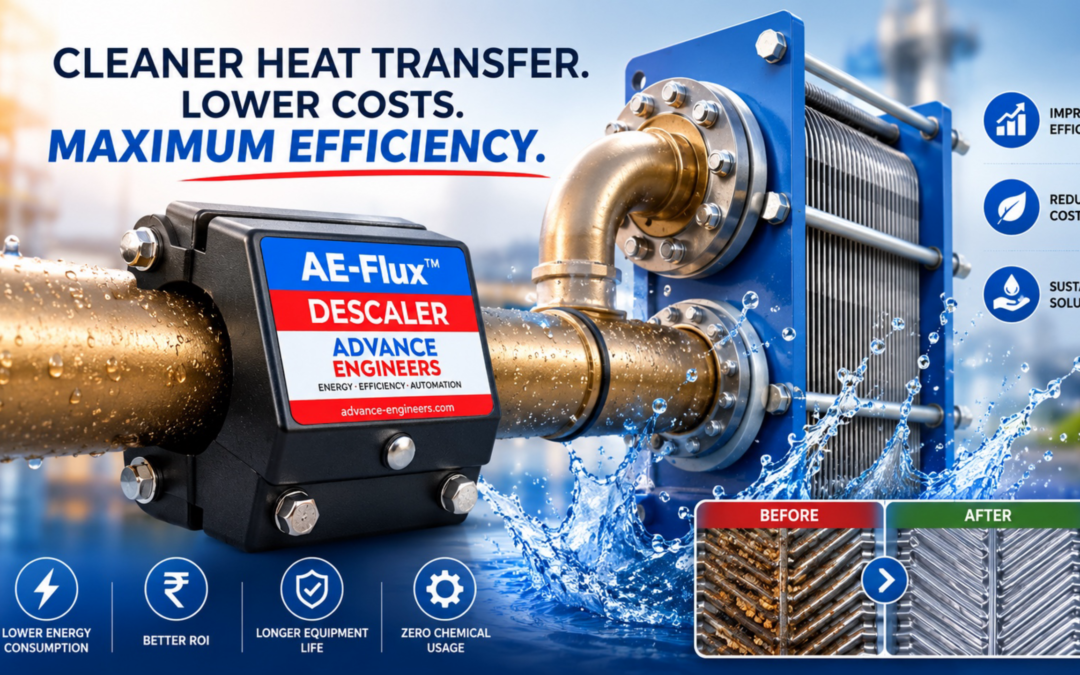
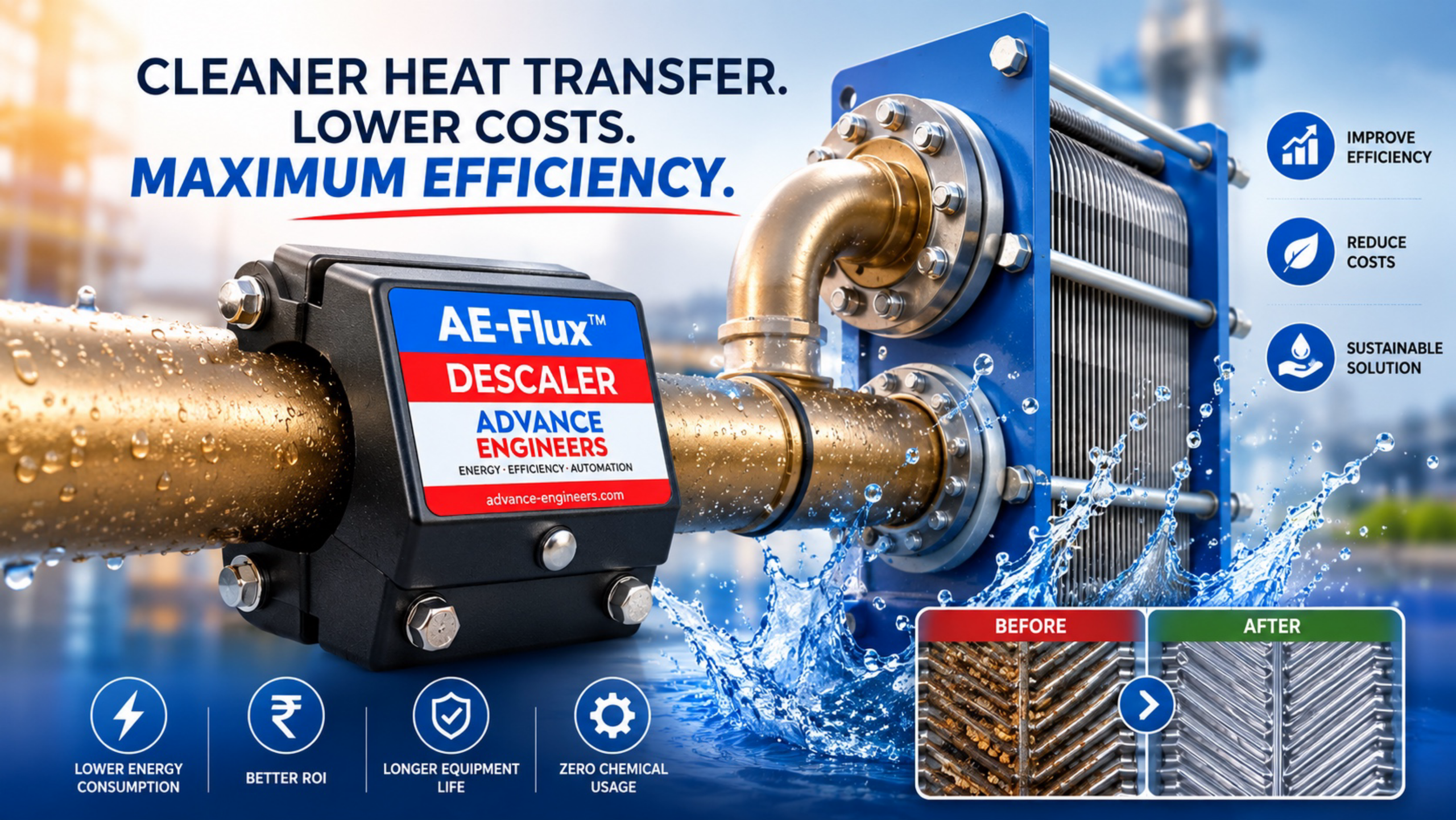
AE FLUX Descaler is a non-invasive inline conditioning device designed to support scale management in industrial water systems.
It is installed externally on the pipeline.
There are:
No moving parts.
No chemicals.
No electricity.
No consumables.
No pressure drop.
No interruption to process flow.
Once installed,
it operates continuously with minimal attention.
Its purpose is to condition flowing water in a manner that helps reduce the tendency of mineral deposits to adhere strongly to heat transfer surfaces, thereby supporting cleaner systems over time.
Typical Applications
AE FLUX Descaler can be considered for:
Plate Heat Exchangers
Shell & Tube Heat Exchangers
Cooling Towers
Chillers
Boilers
Condensers
Cooling Water Lines
Hot Water Circuits
HVAC Systems
Diesel Generator Jacket Cooling
Plastic Injection Moulding
Food Processing
Dairy Plants
Power Plants
Pharmaceutical Utilities
Sugar Mills
Chemical Plants
Oil Refineries
Commercial Buildings
Hotels
Hospitals
Anywhere scaling affects performance,
AE FLUX deserves evaluation.
Expected Operational Benefits
Every application is different.
Performance depends upon:
Water chemistry
Operating temperature
Flow velocity
Existing scale thickness
Operating hours
Maintenance practices
When properly applied,
users typically look for improvements in areas such as:
• More stable heat transfer
• Reduced fouling tendency
• Longer intervals between cleaning
• Lower pressure drop growth
• Reduced maintenance frequency
• Better energy efficiency
• Improved equipment availability
Actual results should always be evaluated based on site operating conditions and performance monitoring.
Engineering Comparison
| Parameter | Conventional Chemical Cleaning | AE FLUX Preventive Descaling |
|---|
| Plant Shutdown | Required | Normally Not Required |
| Chemicals | Required | Not Required |
| Operator Exposure | High | Negligible |
| Waste Disposal | Required | None |
| Environmental Impact | Higher | Lower |
| Continuous Operation | No | Yes |
| Preventive Action | No | Designed for Continuous Conditioning |
| Maintenance Frequency | Periodic | Reduced Intervention Objective |
| Equipment Opening | Frequent | Less Frequent |
| ESG Friendly | Moderate | Strongly Aligned |
Case Study (Illustrative Example)
Industry: Dairy Processing
Heat Exchanger Duty:
Milk Pasteurization
Problem:
Chemical cleaning every four months.
Steam consumption increasing.
Pressure drop rising.
Frequent maintenance.
Production interruption.
Solution:
AE FLUX installed on the recirculating water line.
Performance Review after several months of operation showed:
• Longer intervals between maintenance
• More consistent outlet temperatures
• Reduced tendency for scaling
• Lower cleaning frequency
• Improved production availability
This illustrative example highlights the type of operational improvements industries seek when implementing preventive descaling solutions. Actual results vary depending on water quality, operating conditions, and maintenance practices.
Sustainability Benefits
Every chemical cleaning cycle avoided contributes to:
Reduced chemical consumption
Reduced transportation
Reduced waste generation
Reduced carbon emissions
Lower water usage
Lower maintenance waste
Longer equipment life
Improved ESG performance
For organizations pursuing sustainability targets,
these operational improvements become strategically important.
The Economics of Preventive Maintenance
Many companies evaluate maintenance only by comparing:
Cost of Chemicals
versus
Cost of AE FLUX.
This is incomplete.
A proper engineering evaluation should include:
Steam Savings
Electricity Savings
Reduced Pumping Energy
Lower Maintenance Labour
Reduced Shutdown Cost
Lower Spare Consumption
Reduced Gasket Replacement
Higher Production Availability
Reduced Water Consumption
Reduced Carbon Cost
When these are considered together,
the economics become far more meaningful.
What’s Coming Next
In the next section of this engineering guide, we will move from concepts to numbers.
We will develop a complete engineering case study for a Plate Heat Exchanger, including:
Actual heat transfer calculations
Steam savings estimation
Fouling factor analysis
Pressure drop comparison
Energy cost calculations
Carbon emission reduction
12-month payback model
5-year Return on Investment (ROI)
Industry-specific applications for pharmaceuticals, refineries, HVAC systems, dairies, food processing, and power plants
The objective is simple: to help plant engineers evaluate preventive descaling using engineering principles and economic analysis rather than assumptions.
Continue Exploring
Want to estimate the potential savings for your own plant?
Visit the AE FLUX page and use the Online Payback Calculator to evaluate your application.
https://advance-engineers.com/wateraeflux/
Our engineering team will be happy to discuss your operating conditions and help determine whether AE FLUX is suitable for your system.